What are Nanomaterials ?
As it makes things smaller, it has more impact on our lives; such is the beauty of nanomaterials.
Nanomaterials can be defined as materials possessing, at minimum, one external dimension measuring 1-100nm. The definition given by the European Commission states that the particle size of at least half of the particles in the number size distribution must measure 100nm or below.
Image source –https://www.niehs.nih.gov/health/topics/agents/sya-nano/index.cfm
Nanomaterials can occur naturally, be created as the by-products of combustion reactions, or be produced purposefully through engineering to perform a specialized function. These materials can have different physical and chemical properties to their bulk-form counterparts.

Nanomaterials can occur naturally, be created as the by-products of combustion reactions, or be produced purposefully through engineering to perform a specialized function. These materials can have different physical and chemical properties to their bulk-form counterparts.
How can nanomaterials be characterized?
Detailed assessments may include the following: Descriptions of nanomaterials ought to include the average particle size, allowing for clumping and the size of the individual particles and a description of the particle number size distribution (range from the smallest to the largest particle present in the preparation).
1. Physical properties:
Size, shape, specific surface area, and ratio of width and height
Whether they stick together
Number size distribution
How smooth or bumpy their surface is
Structure, including crystal structure and any crystal defects
How well they dissolve
2. Chemical properties:
Molecular structure
Composition, including purity, and known impurities or additives
Whether it is held in a solid, liquid or gas
Surface chemistry
Attraction to water molecules or oils and fats
A range of techniques for tracking nanoparticles exist, and new ones are under development. Realistic ways of preparing nanomaterials for testing of their possible effects on biological systems are also being developed.
Applications of Nanomaterials in various Industries
The use of nanomaterials is prevalent in a wide range of industries and consumer products, from healthcare and cosmetics to environmental preservation , these are just a few examples in which nanotechnology is being applied. Other than that, nanotechnology has far-reaching applications and even farther-reaching future potential in an extremely wide range of possibilities. Let us now see how this tiny tech is impacting us and securing our future.
Nanobots and teeth:
The application of nanotech in the dental field is called Nano dentistry, and it is an innovative new technology that has made huge strides in dentistry. There are several new dental products available, ranging from implants to oral hygiene products that utilize this technology.

Image source – Nanodentistry
Nano dentistry is being used to diagnose, treat, and prevent oral and dental diseases. It is also being used to relieve pain and improve dental health. Companies are already manufacturing products like Nano-impressions, Nano-ceramics, Nano-composites, Nano-fillers, to name a few. Nano dentistry can also be used in the treatment of oral cancer, which can have ground-breaking effects in medical science if successfully mastered.
Other applications that dental researchers are currently looking into include:
Endodontic therapy
Preventing dental decay
Integration with dental implants
Treating periodontal disease
Screws for bone fixation
Direct pulp-capping procedures
Dentin regeneration
Enhanced bone regeneration
Producing artificial mucosa, etc.
Fight against climate change:
One of the key ways to fight against climate change is by devising newer and more effective methods to produce electricity. Thanks to advances in nanoscience, we are already seeing batteries that can store more energy for electric cars and solar panels that can convert sunlight to electricity more efficiently.

Image source – The Conversation
Both these applications use nanotexturing to turn a flat surface into a 3D one with a much greater surface area. This allows for more space for reactions to take place, thus enabling higher energy storage or generation.
The future can show us nanoparticles that can harvest energy from their environment with high conversion efficiency. For example, energy can be harvested from movement, light, variations in temperature, glucose and several other sources.
Military applications:
The military, no matter which country, has seen tremendous potential in nanotechnology. So, it comes as no surprise that a majority of nanoscience research is sponsored by the military and thus, focused on military applications. These can span a wide spectrum of developments, such as:

Image source – ResearchGate
Improvement in medical and casualty care for soldiers. For example, wound dressings coated with certain nanomaterials allow for control of the release of drugs and proteins for a specified period of time, which can ultimately accelerate wound healing.
Production of lightweight, strong and multi-functional materials for use in military clothing, offering better protection as well as enhanced connectivity. Current research in nanotech has also allowed the development of durable nonwoven fabrics that can impart water absorbance or repellence, fire and thermal resistance, antimicrobial treatment, to name a few.
Enhancement of military intelligence using smart sensor technologies in which Nano-sensors are integrated with neural networks. Nano-sensors can be used to detect harmful chemicals and biological weapons, damages in military equipment, nature and the magnitude of the potential risk when explosives are detected.
Use of energetic Nano-particles in propulsion applications due to their unique combustion properties such as rapid ignition and short combustion times. For instance, they can be included in solid fuels, solid propellants, energetic gallants in liquid systems, etc.
Nanocomposites are another category whether there is tremendous ongoing research and a wide range of potential use cases. Current developments in nanocomposites are focused on use in military food packaging, ballistic protection and body armour, solid lubricants, shock-absorbing materials, electrostatic charge dissipation, electromagnetic shielding, fire retardation and corrosion protection.
Developments of Nano sized drones that could be used in surveillance, remote detonations, communication, to name a few. These drones can have long battery lives with Nano-sensors that allow facial and object detection.
Uses of nanotechnology for markedly smaller satellites together with smaller launch vehicles, thus, making these satellites cost-effective. Moreover, these Nano-satellites could be used in swarms for radar, communication and intelligence.

Image source –https://www.mdpi.com/2673-687X/1/2/8
In the construction industry ,Carbon nanotubes, replacing steel constructions, carbon nanofibers or Nano clay enhance their mechanical properties. Nanoparticles can also be used for repairing mortars or future self-healing concrete and cracks recovery.
In Computer industry, Nanotechnology is used to make small computing devices such as smartphones. Nanotechnology may eventually replace the hard drive disk. The demand for smaller devices challenged chip engineers and manufacturers to design high-powered chips in smaller packages.
In Aerospace, carbon nanotubes can be used in the morphing of aircraft wings. The nanotubes are used in a composite form to bend in response to the application of an electric voltage. Elsewhere, environmental preservation processes make use of nanomaterials too - in this case, nanowires. Applications are being developed to use the nanowires - zinc oxide nanowires- in flexible solar cells as well as to play a role in the treatment of polluted water.

In the cosmetics industry, mineral nanoparticles –such as titanium oxide –are used in sunscreen, due to the poor stability that conventional chemical UV protection offers in the long-term. Just as the bulk material would, titanium oxide nanoparticles are able to provide improved UV protection while also having the added advantage of removing the cosmetically unappealing whitening associated with sunscreen in their Nano-form.
The sports industry has been producing baseball bats that have been made with carbon nanotubes, making the bats lighter therefore improving their performance. Further use of nanomaterials in this industry can be identified in the use of antimicrobial nanotechnology in items such as the towels and mats used by sportspeople, in order to prevent illnesses caused by bacteria.
The use of Nano-titanium dioxide also extends to use in coatings to form self-cleaning surfaces, such as those of plastic garden chairs. A sealed film of water is created on the coating, and any dirt dissolves in the film, after which the next shower will remove the dirt and essentially clean the chairs.
Nanotechnology could be used to enhance the possibilities of developing conventional and stranded gas resources and to improve the drilling process and oil and gas production by making it easier to separate oil and gas in the reservoir. Nanotechnology can make the oil and gas industry considerably greener.
Advantages of Nanomaterials
The properties of nanomaterials, particularly their size, offer various different advantages compared to the bulk-form of the materials, and their versatility in terms of the ability to tailor them for specific requirements accentuates their usefulness. An additional advantage is their high porosity, which again increases demand for their use in a multitude of industries.
In the energy sector, the use of nanomaterials is advantageous in that they can make the existing methods of generating energy - such as solar panels - more efficient and cost-effective, as well as opening up new ways in which to both harness and store energy.

Image source – https://www.sun.edu.ng/knowledge-update/advantages-disadvantages-of-nanotechnology
Nanomaterials are also set to introduce a number of advantages in the electronics and computing industry. Their use will permit an increase in the accuracy of the construction of electronic circuits on an atomic level, assisting in the development of numerous electronic products.
The very large surface-to-volume ratio of nanomaterials is especially useful in their use in the medical field, which permits the bonding of cells and active ingredients. This results in the obvious advantage of an increase in the likelihood of successfully combating various diseases.
Disadvantages of Nanomaterials
Alongside their benefits, there are also a number of disadvantages associated with nanomaterial use. Due to the relative novelty of the widespread use of nanomaterials, there is not a large amount of information on the health and safety aspects of exposure to the materials.
Currently, one of the main disadvantages associated with nanomaterials is considered to be inhalation exposure. This concern arises from animal studies, the results of which suggested that nanomaterials such as carbon nanotubes and nanofibers may cause detrimental pulmonary effects, such as pulmonary fibrosis. Further possible health risks are ingestion exposure and dust explosion hazards.
Additionally, there are still knowledge gaps regarding nanomaterials, meaning the manufacturing process can often be complex and difficult. The overall process is also expensive, requiring optimum results - especially regarding their use in consumer goods - in order to avoid financial losses.

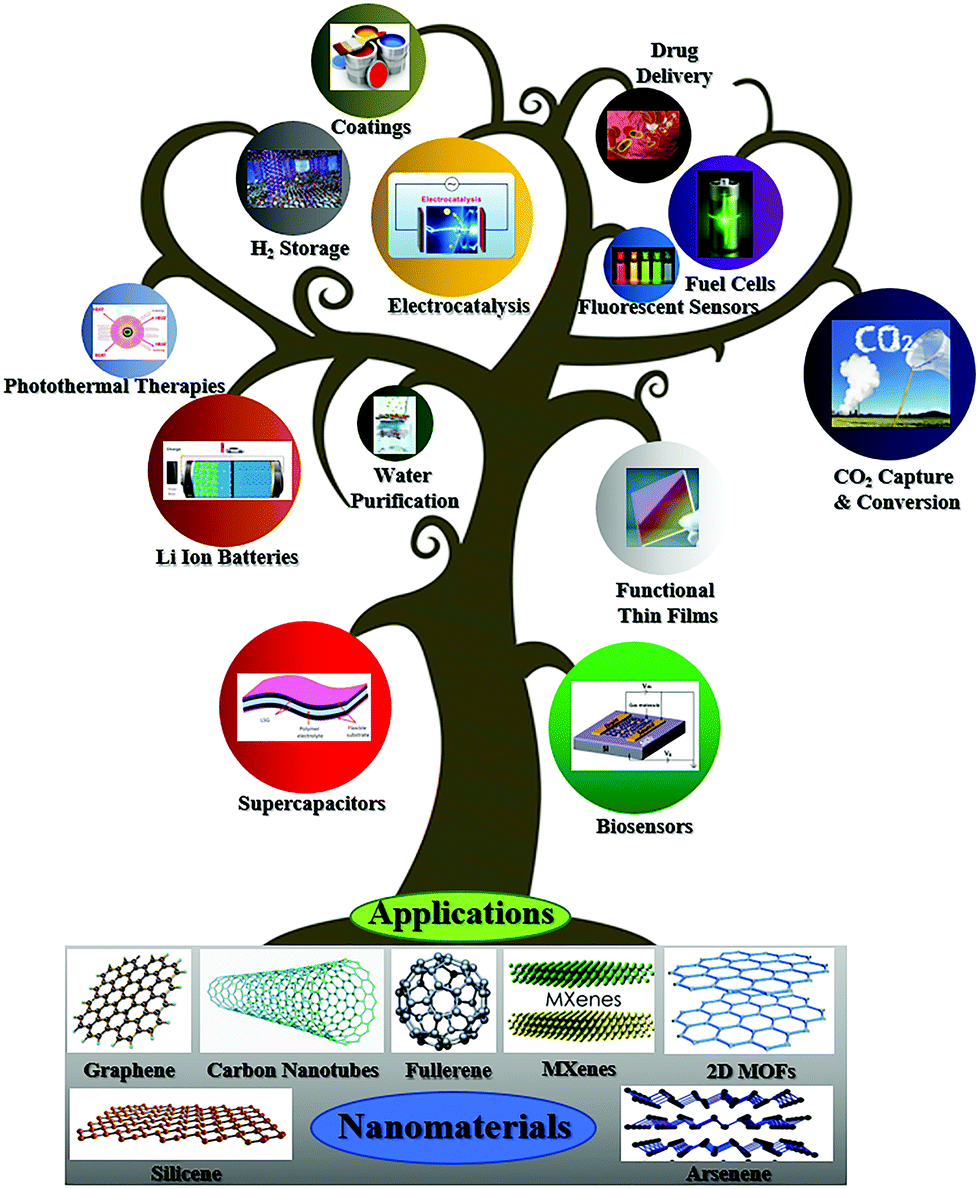
Image source – https://www.sun.edu.ng/knowledge-update/advantages-disadvantages-of-nanotechnology
Risk-assessments concerning any potential environmental effects indicate that nanomaterials used in cosmetic items such as sunscreen, which are applied to the skin, run the risk of ending up in aquatic ecosystems after they are washed off. Nanomaterials that have been engineered may also end up in water bodies such as lakes and rivers, before accumulating to create particles of a larger size. This may put freshwater species - such as snails- at risk by possibly inducing a decline in life processes such as growth and reproduction. The same issues caused by the materials in such freshwater ecosystems are likely to pertain to marine ecosystems as well. Accumulation of nanomaterials in other aspects of the environment, such as soils - through sewage sludge - is an additional concern. Although the concentrations of these engineered nanomaterials is expected to be quite small, repeated release may cause the concentrations to increase over time, exacerbating the related negative effects.
Conclusion
Nanotechnology can change dental medicine, healthcare, and human life profoundly more than several developments of the past. However, they even have the potential to evoke important advantages, like improved health, higher use of natural resources, and reduced environmental pollution.
References:
1.Nanobiotechnology Medical Applications: Overcoming Challenges Through Innovation July 2018 The EuroBiotech Journal 2(3):146-
2.Multifunctional Gold Nanoparticles: A Novel Nanomaterial for Various Medical Applications and Biological Activities
3.Nanomaterial Chemistry and Technology (ISSN 2690-2575) https://edelweisspublications.com/keyword/26/1744/Applications-of-Nanomaterials
4.What Is the Role of Nanotechnology in Computers?
https://www.easytechjunkie.com/what-is-the-role-of-nanotechnology-in-computers.htm
5.Nanomaterials in the Construction Industry: A Review of Their Applications and Environmental Health and Safety Considerations Jaesang Lee
Comments
Post a Comment